

A LEGACY THAT LIVES ON
FAITH, FREEDOM, RESILIENCE
Explore the remarkable journey of Poland and the spirit of generation.
Step into the story of Poland and discover a heritage shaped by resilience, faith, innovation, and an enduring pursuit of freedom. From the prehistoric settlement of Biskupin to the rise of kings, scholars, artists, patriots, and world-changing leaders, this journey spans more than 2,700 years of remarkable history. Explore the triumphs and challenges that forged the Polish nation, including battles for independence, cultural achievements, scientific breakthroughs, and the unwavering spirit of generations who refused to surrender their identity. Whether you are tracing your family roots, deepening your understanding of Polish history, or celebrating the legacy of Polish-Americans, this timeline invites you to connect with the people, events, and values that continue to inspire Poland and its descendants around the world.
Key Events
Biskupin
Baptism of Poland
Boleslaw I the brave
Battle of Gunwald
Copernicus
University of Krakow
Battle of Varna
May 3rd Constitution
Panna Maria, Texas
Independence Regained
Miracle of the Vistula
Warsaw Uprising
Solidarity Movement
Pope John Paul II
Bronze & Iron Age
740 BC
Biskupin
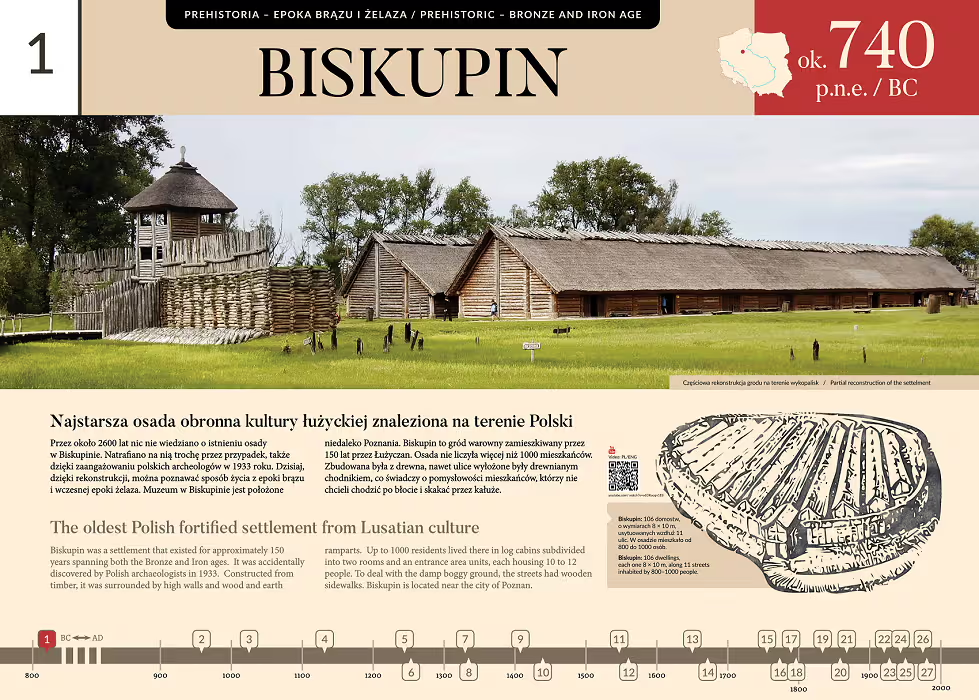
Biskupin, dating to around 740 BC, is one of the most important archaeological sites in Poland and one of the best-preserved prehistoric settlements in Europe. Built by the Lusatian culture, the fortified settlement featured carefully planned streets, wooden homes, and strong defensive walls. Its discovery in 1933 provided remarkable insight into life during the Bronze and Iron Ages on Polish lands. Today, Biskupin stands as a symbol of Poland's ancient heritage and the ingenuity of its early inhabitants.
The Middle Ages
966 AD
Poland Accepts Christianity

Poland accepts Christianity in 966 AD, This historic event strengthened Poland's ties with Western Europe and helped unify the emerging Polish state. The baptism brought important religious, cultural, and political changes that shaped the nation's future. Today, the Baptism of Poland is recognized as a foundational moment in Polish history and national identity.
The Middle Ages
1025 AD
Coronation of Boleslaw I the Brave

Bolesław I the Brave became the first crowned King of Poland in 1025, marking a major milestone in the development of the Polish state. A skilled military leader and diplomat, he expanded Poland's influence and strengthened its position in Central Europe. His reign built upon the foundations established by his father, Mieszko I, and helped secure Poland's independence and prestige. The coronation symbolized Poland's emergence as a recognized kingdom within the community of European nations.
The Middle Ages
1138 AD
Feudal Fragmentation by Boleslaw III Wrymouth

Bolesław I the Brave became the first crowned King of Poland in 1025, marking a major milestone in the development of the Polish state. A skilled military leader and diplomat, he expanded Poland's influence and strengthened its position in Central Europe. His reign built upon the foundations established by his father, Mieszko I, and helped secure Poland's independence and prestige. The coronation symbolized Poland's emergence as a recognized kingdom within the community of European nations.
The Middle Ages
1241 AD
Taras invade Poland

In 1241, the Mongol (Tatar) invasion reached Poland, bringing devastation to many towns and regions across the country. The decisive Battle of Legnica saw Polish and allied European forces, led by Duke Henry II the Pious, confront the invading army. Although Henry II was killed and the battle was lost, the resistance helped slow the Mongol advance into Europe. The courage displayed at Legnica became a lasting symbol of sacrifice, determination, and the defense of Christian Europe.
The Middle Ages
1264 AD
Statute of Kalisz
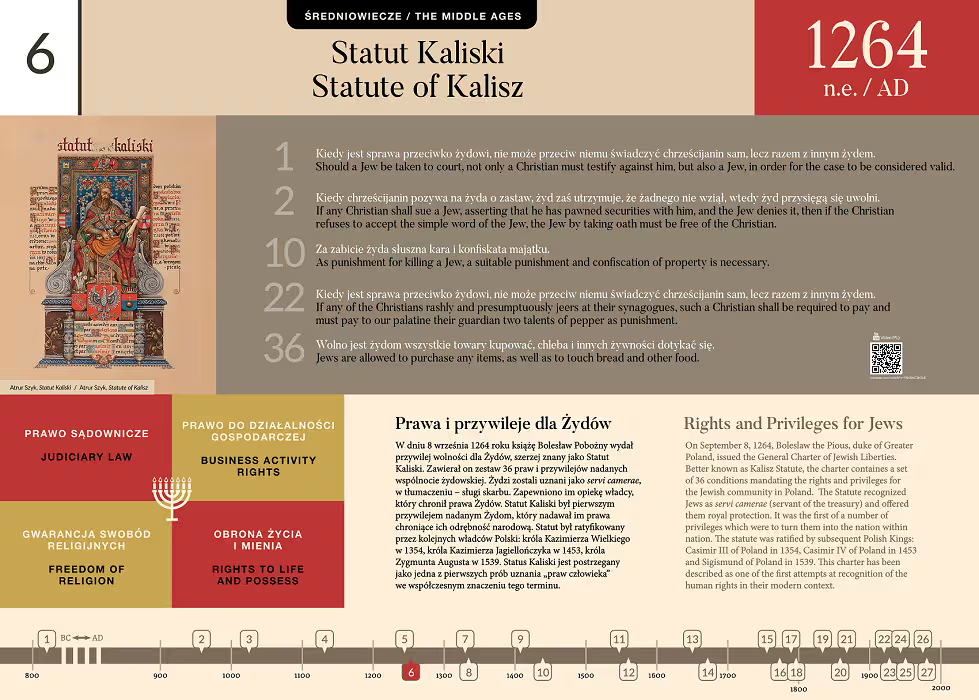
In 1264, Duke Bolesław the Pious issued the Statute of Kalisz, one of the most important legal charters in medieval Poland. The statute granted Jewish communities protection, religious freedom, and rights related to trade, property, and justice. These guarantees helped make Poland a place of relative tolerance and opportunity compared to many other parts of Europe at the time. The Statute of Kalisz became a cornerstone of Jewish life in Poland and is often regarded as an early example of legal protection for minority rights.
The Middle Ages
1333-1370 AD
Casimir III the Great, King of Poland
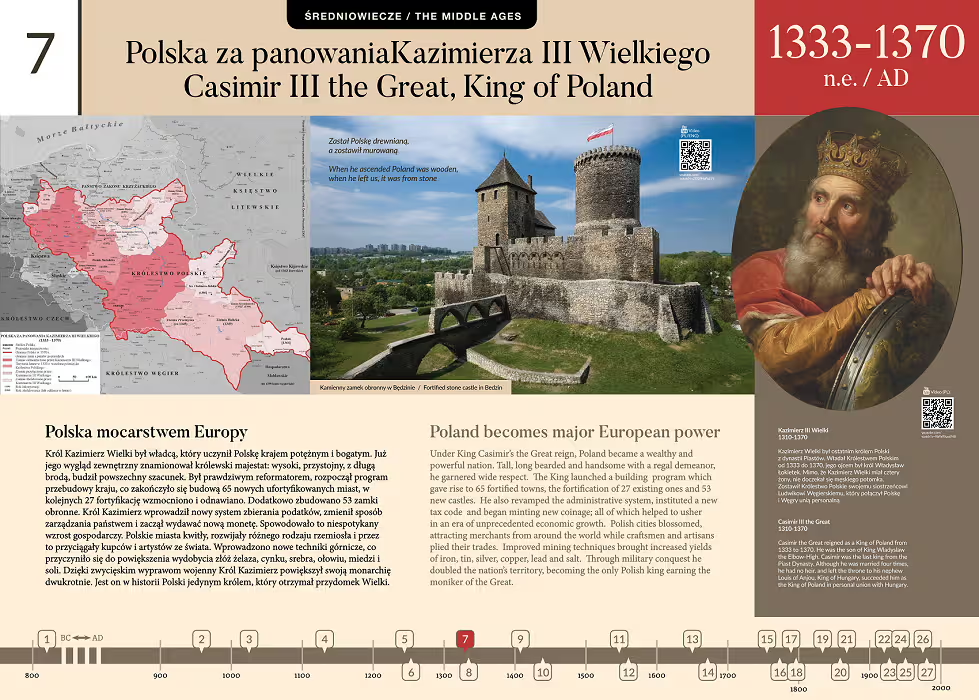
During the reign of King Casimir III the Great (1333-1370), Poland experienced a period of remarkable growth, stability, and prosperity. Casimir strengthened the kingdom through legal reforms, economic development, and the construction of castles, fortifications, and towns across the country. His policies encouraged trade, improved governance, and expanded Poland's influence throughout Central Europe. For transforming Poland into a strong and respected European power, he became the only Polish king to earn the title "the Great."
The Middle Ages
1364 AD
Founding of the University of Kraków
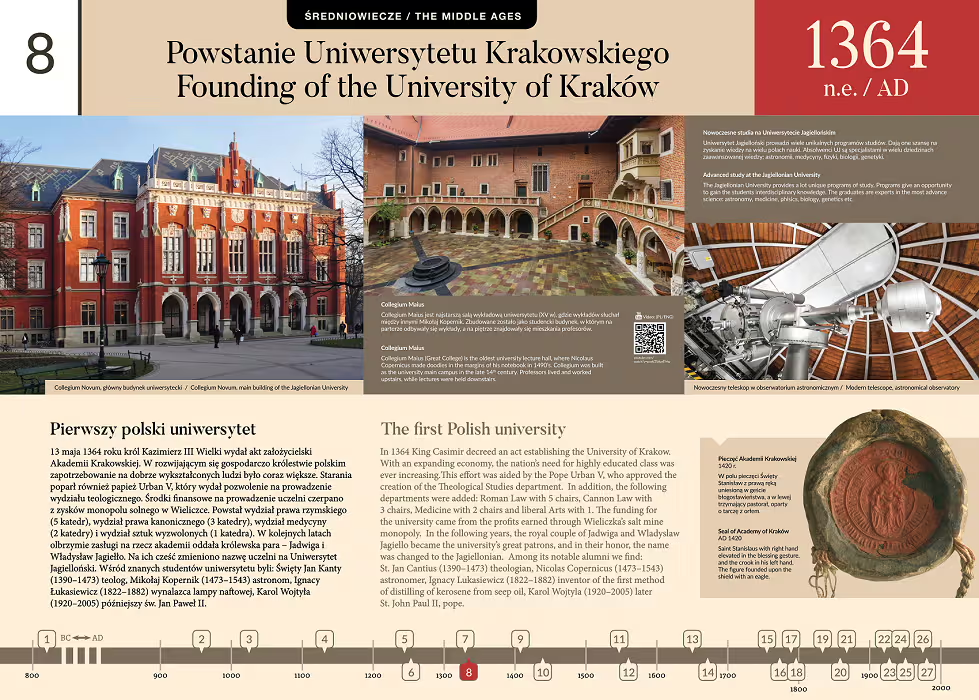
During the reign of King Casimir III the Great (1333-1370), Poland experienced a period of remarkable growth, stability, and prosperity. Casimir strengthened the kingdom through legal reforms, economic development, and the construction of castles, fortifications, and towns across the country. His policies encouraged trade, improved governance, and expanded Poland's influence throughout Central Europe. For transforming Poland into a strong and respected European power, he became the only Polish king to earn the title "the Great."
The Middle Ages
1410 AD
Battle of Gunwald
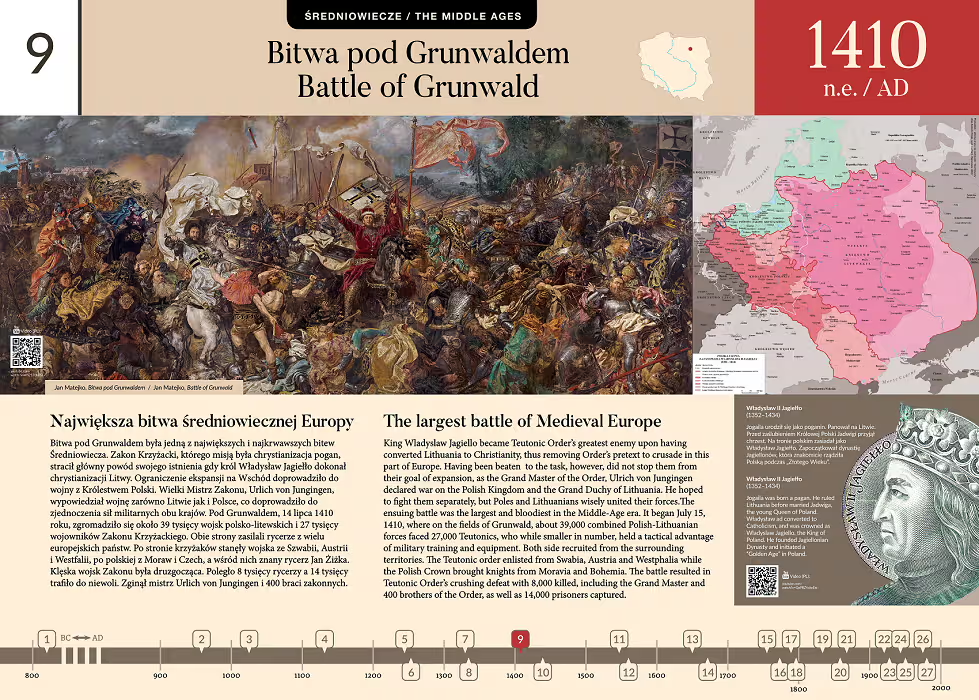
The Battle of Grunwald, fought on July 15, 1410, was one of the largest and most significant battles of medieval Europe. Polish and Lithuanian forces, led by King Władysław Jagiełło, achieved a decisive victory over the Teutonic Order, ending its military dominance in the region. The triumph strengthened the Polish-Lithuanian alliance and elevated its status as a major European power. Today, Grunwald remains a symbol of unity, courage, and one of the greatest military victories in Polish history.
The Middle Ages
1444 AD
Battle of Varna
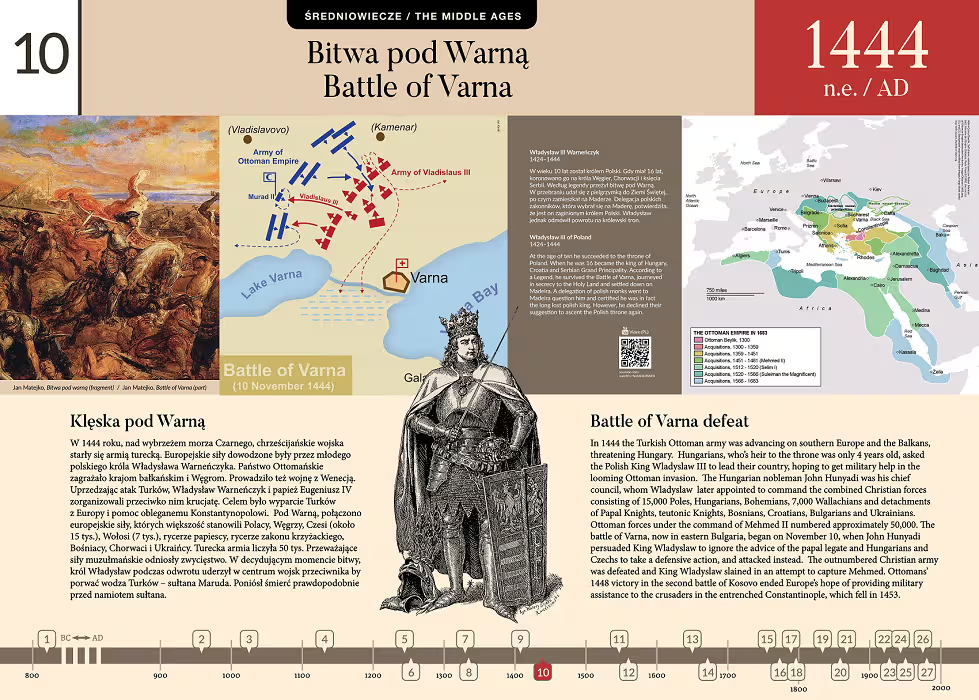
The Battle of Varna, fought in 1444, was a pivotal clash between a Christian coalition and the expanding Ottoman Empire. Led by the young Polish and Hungarian King Władysław III, the allied forces sought to halt Ottoman advances into Europe. Despite their determination, the crusader army was defeated, and King Władysław was killed in battle, becoming a symbol of courage and sacrifice. The defeat marked a major turning point in the struggle against Ottoman expansion and remains an important chapter in Polish and European history.
Early Modern
1543 AD
Heliocentric theory of Nicolaus Copernicus
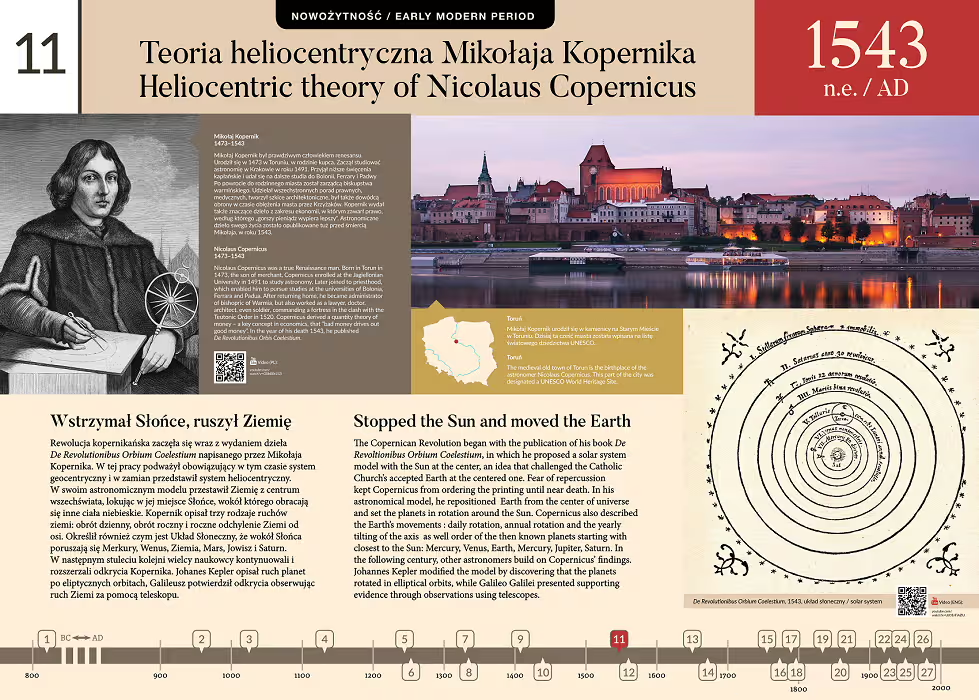
In 1543, Polish astronomer Nicolaus Copernicus published his groundbreaking heliocentric theory, proposing that the Earth and other planets revolve around the Sun. His work challenged centuries of accepted belief and transformed humanity's understanding of the universe. Published in De Revolutionibus Orbium Coelestium, the theory laid the foundation for modern astronomy and the Scientific Revolution. Copernicus' discovery remains one of the most influential scientific achievements in world history and a lasting source of pride for Poland.
Early Modern
1569 AD
Union of Lublin
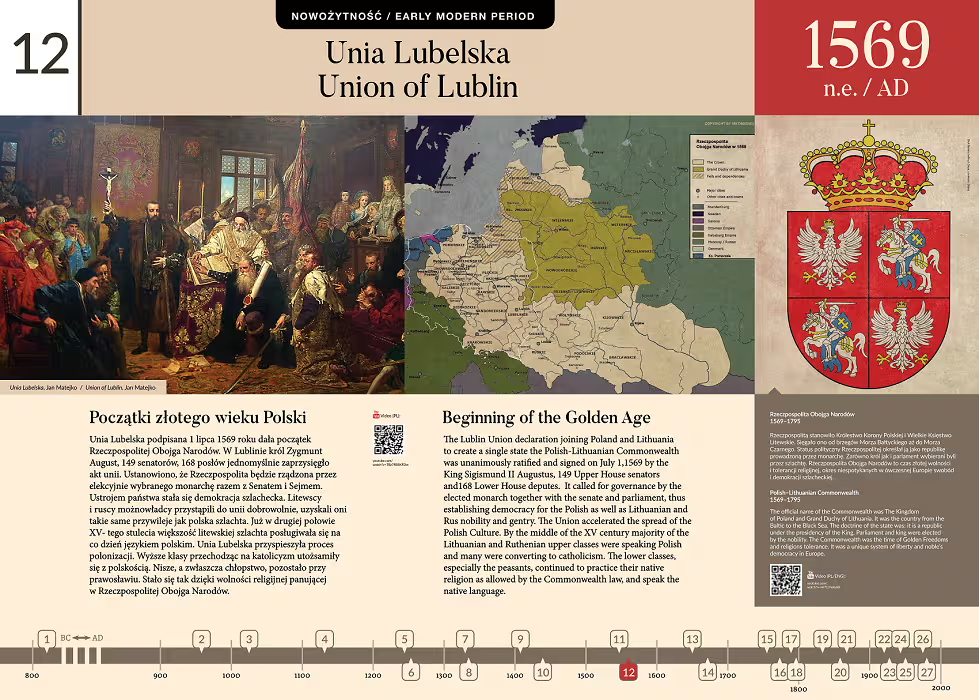
The Union of Lublin, signed in 1569, united the Kingdom of Poland and the Grand Duchy of Lithuania into the Polish-Lithuanian Commonwealth, one of the largest states in Europe. The agreement created a shared monarch, parliament, and foreign policy while preserving certain separate institutions within each nation. This political partnership ushered in a period of prosperity, cultural achievement, and growing influence known as Poland's Golden Age. The Commonwealth became a unique model of cooperation and representative government that shaped Central and Eastern Europe for centuries.
Early Modern
1655 AD
Deluge - Poland overrun by Swedes
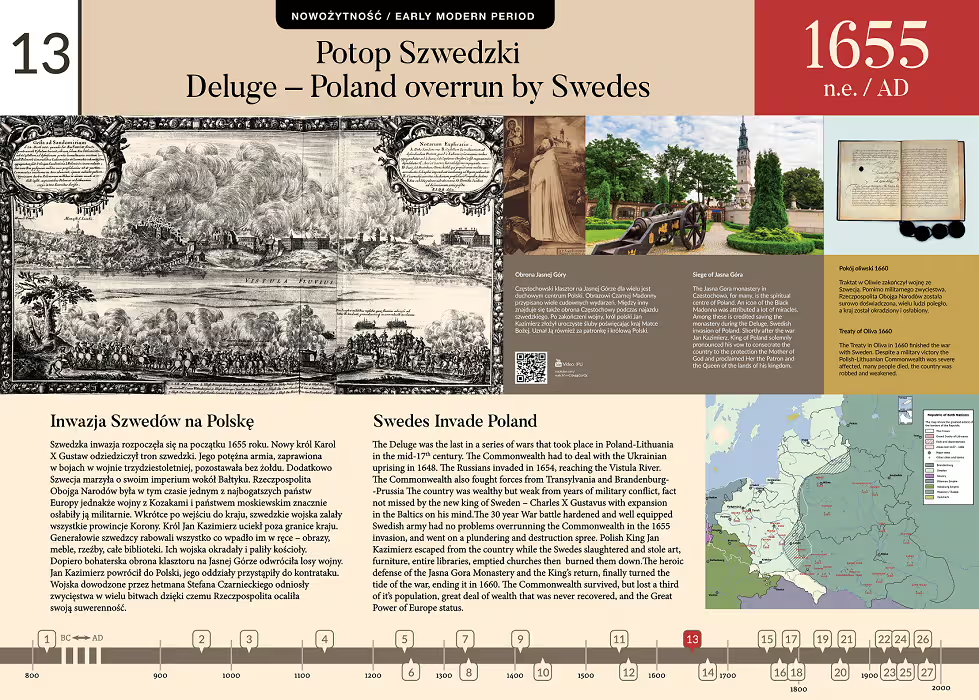
The Swedish Deluge, which began in 1655, was one of the most devastating invasions in Polish history, bringing widespread destruction to the Polish-Lithuanian Commonwealth. Swedish armies occupied much of the country, plundered cities, and caused enormous economic and cultural losses. A turning point came with the successful defense of the monastery at Jasna Góra, which inspired resistance and strengthened national resolve. Although Poland ultimately expelled the invaders, the war left the Commonwealth weakened and marked the beginning of a long period of decline.
Early Modern
1683 AD
Battle of Vienna
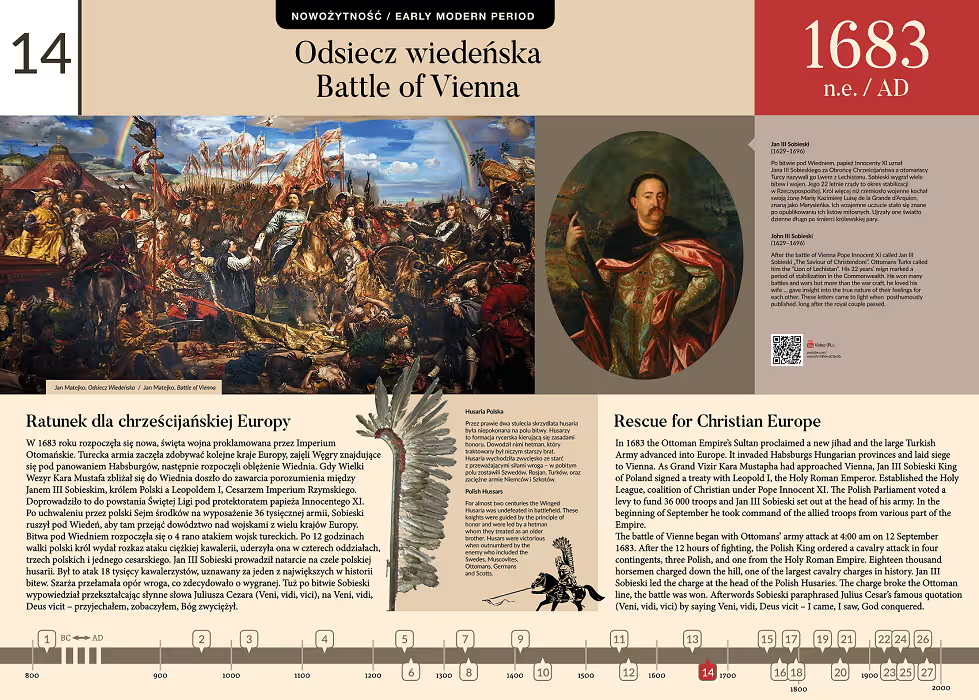
The Battle of Vienna in 1683 was a decisive victory that halted the advance of the Ottoman Empire into Central Europe. King John III Sobieski led a coalition army to relieve the besieged city of Vienna, launching one of the largest cavalry charges in history. The triumph secured his reputation as one of Europe's greatest military leaders and earned Poland lasting recognition for its role in defending the continent. The victory is remembered as a turning point in European history and a symbol of courage, leadership, and international cooperation.
Early Modern
1776-84 AD
Kościuszko and Pulaski
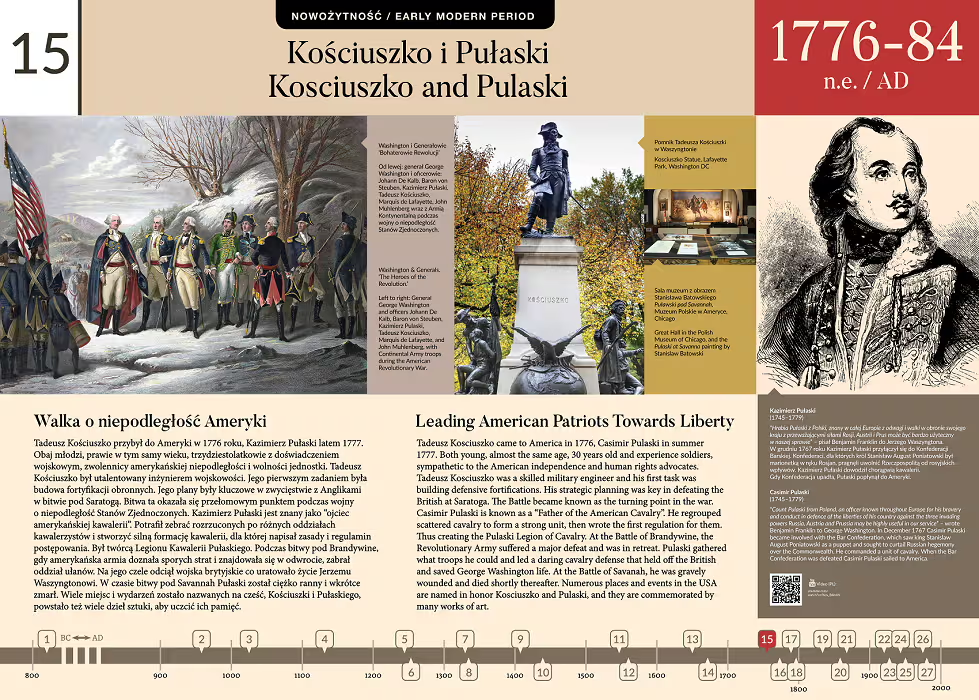
During the American Revolution, Polish patriots Tadeusz Kościuszko and Casimir Pulaski made lasting contributions to the fight for American independence. Kościuszko's engineering skills helped strengthen key American defenses, while Pulaski earned recognition as the "Father of the American Cavalry." Both men brought their military experience and commitment to liberty to support the revolutionary cause. Their service forged a lasting bond between Poland and the United States and secured their place among the heroes of both nations.
Early Modern
1791 AD
May 3rd Constitution
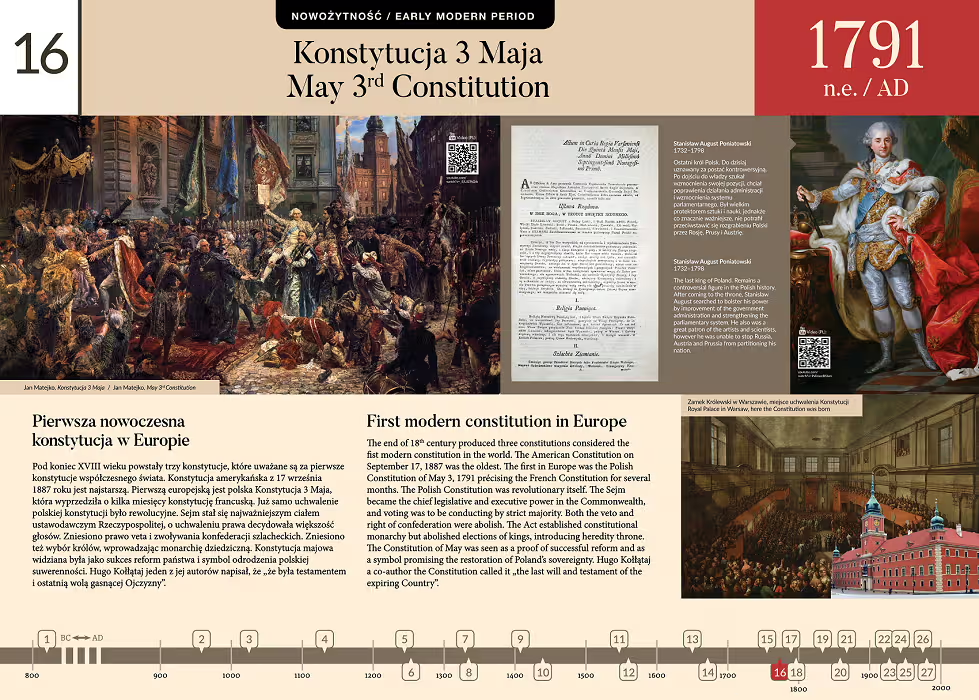
The May 3rd Constitution of 1791 was a landmark reform that sought to strengthen and modernize the Polish–Lithuanian Commonwealth. Widely regarded as Europe’s first modern written constitution and the world’s second after the United States Constitution, it introduced significant political and social reforms. The document aimed to improve governance, limit political abuses, and protect the sovereignty of the nation. Although its implementation was short-lived, the Constitution became a lasting symbol of Polish democracy, patriotism, and the pursuit of liberty.
Early Modern
1794 AD
Kościuszko Insurrection
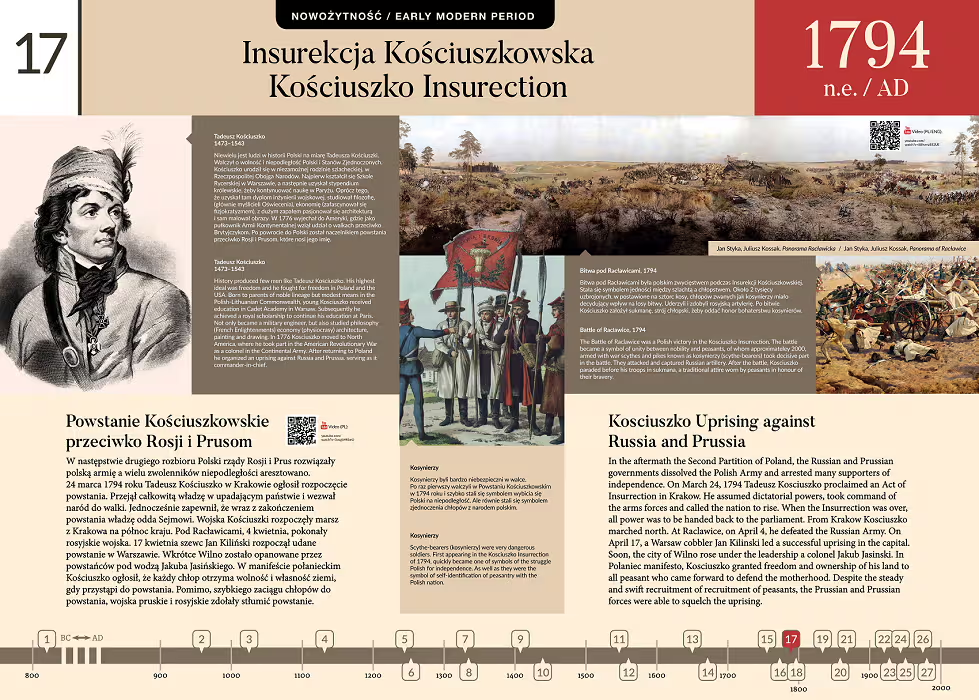
The Kościuszko Insurrection of 1794 was a national uprising led by Tadeusz Kościuszko in an effort to defend Poland's independence against Russian and Prussian domination. Following the partitions of Poland, Kościuszko rallied soldiers, nobles, and common citizens to resist foreign control and restore national sovereignty. The uprising featured notable victories and widespread public participation, symbolizing the determination of the Polish people to preserve their nation. Although ultimately unsuccessful, the insurrection became an enduring symbol of patriotism, sacrifice, and the struggle for freedom.
Early Modern
1795 AD
Partitions of Poland
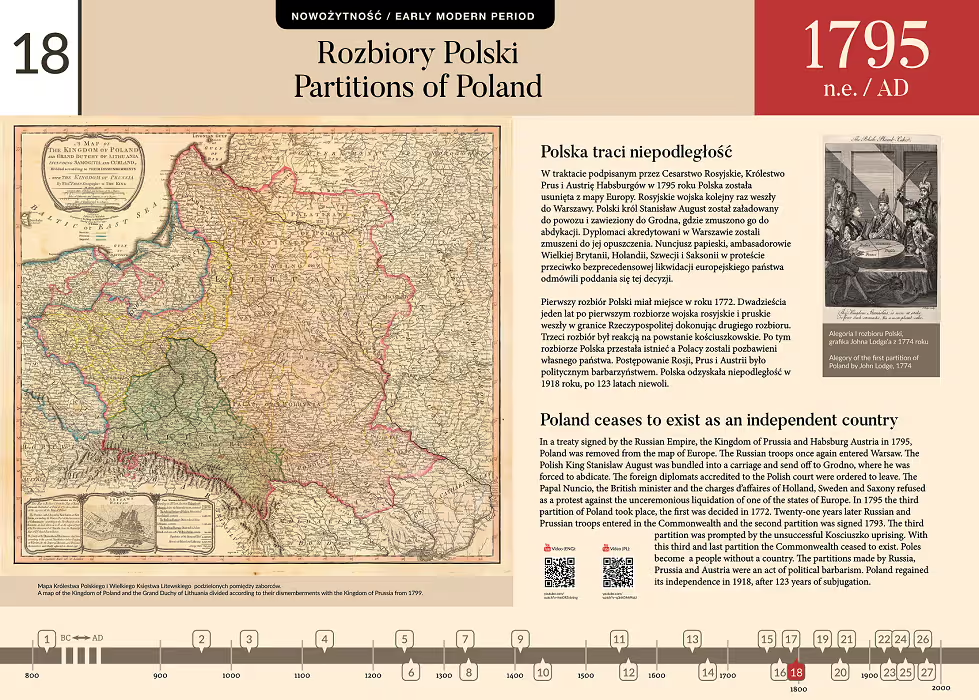
The Partitions of Poland culminated in 1795 when Russia, Prussia, and Austria divided the remaining Polish territory among themselves, erasing Poland from the map of Europe. After a series of invasions and political pressures, the Polish–Lithuanian Commonwealth ceased to exist as an independent state. Despite losing their nation, the Polish people preserved their language, culture, and national identity throughout more than a century of foreign rule. Poland ultimately regained its independence in 1918, making the partitions a powerful symbol of both national tragedy and resilience.
Early Modern
19th Century AD
Golden Era of Polish Romanticizm
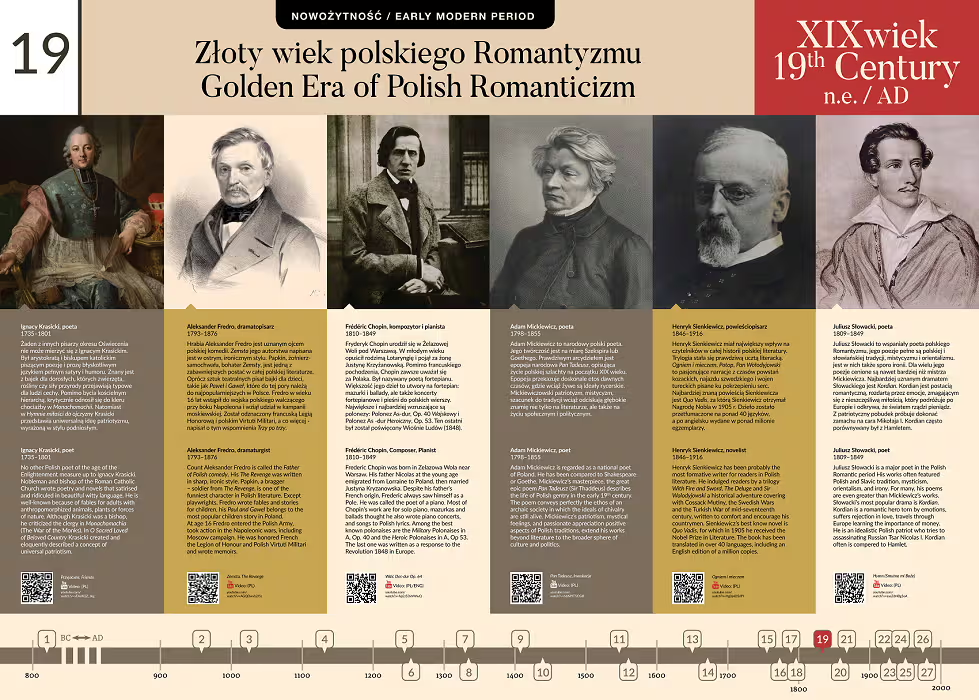
The 19th century is often called the Golden Era of Polish Romanticism, a period when literature, music, and art helped preserve Polish identity during the years of foreign occupation. Great cultural figures such as Adam Mickiewicz, Juliusz Słowacki, and Frédéric Chopin inspired generations with works celebrating freedom, patriotism, and national heritage. Through poetry, novels, and music, these artists kept alive the dream of an independent Poland despite the country's absence from the map of Europe. Their enduring legacy continues to shape Polish culture and serves as a testament to the resilience of the Polish spirit.
Early Modern
1830, 1863 AD
Uprisings Against Russian Ocupiers
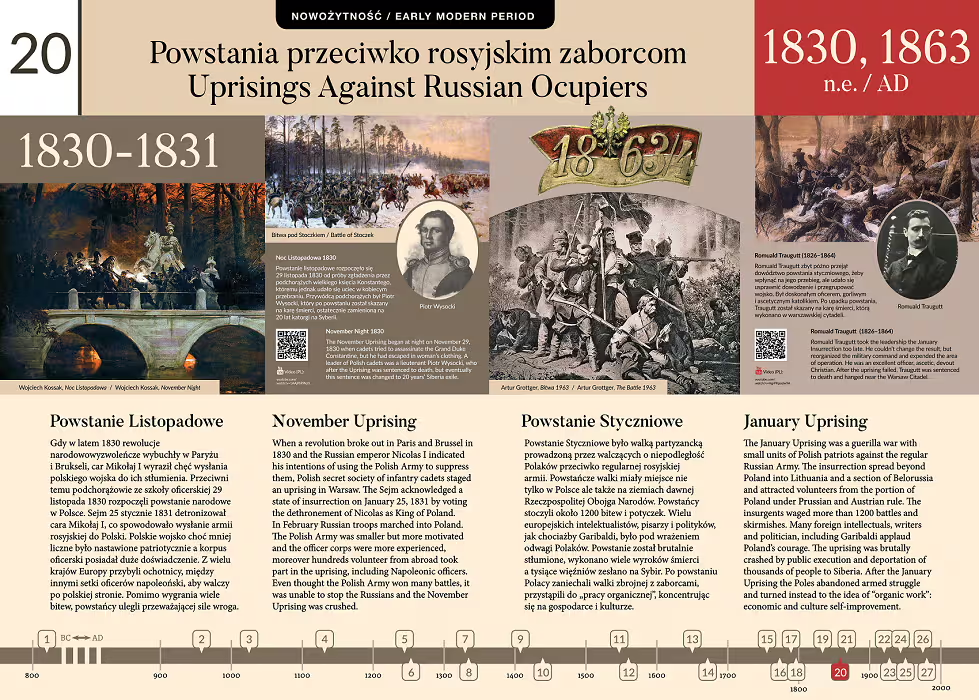
The November Uprising of 1830-1831 and the January Uprising of 1863-1864 were major efforts by the Polish people to regain independence from Russian rule. Inspired by patriotism and a desire for freedom, thousands of Poles took up arms despite overwhelming military odds. Although both uprisings were ultimately suppressed, they kept alive the spirit of resistance and strengthened national identity during the years of partition. Their legacy became a powerful symbol of sacrifice, perseverance, and Poland's enduring struggle for self-determination.
Early Modern
1864 AD
First polish Settlement in USA
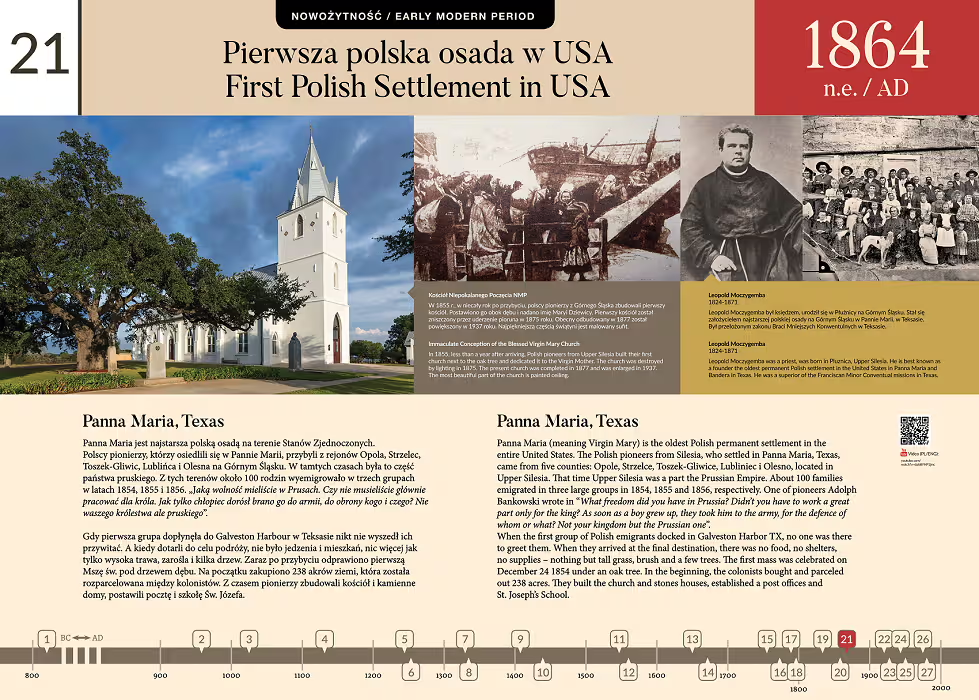
In 1854, Polish immigrants founded Panna Maria, Texas, the first permanent Polish settlement in the United States. Led by Father Leopold Moczygemba, the settlers came seeking economic opportunity, religious freedom, and a better future for their families. Through determination and hard work, they built homes, farms, a church, and a thriving community that preserved Polish traditions and culture. Panna Maria became the foundation of Polish-American life in the United States and remains an important symbol of the immigrant experience.
Contemporary
1918 AD
Poland Regains Its Independence
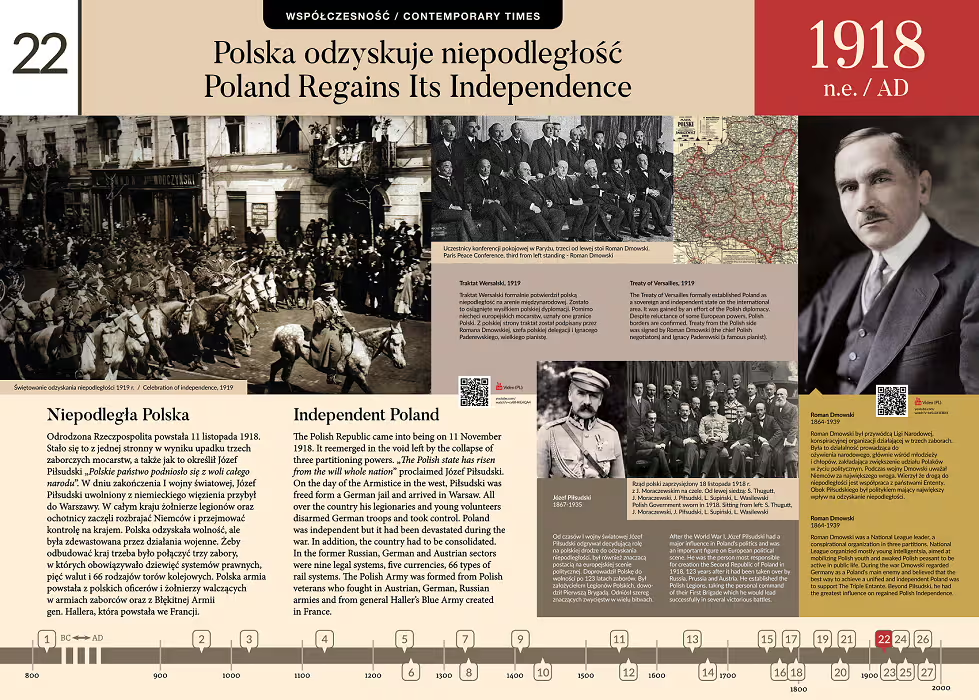
In 1918, after 123 years of partition and foreign rule, Poland regained its independence and reemerged as a sovereign nation. The collapse of the Russian, German, and Austro-Hungarian empires at the end of World War I created the opportunity for Poland's rebirth. Leaders such as Józef Piłsudski and Roman Dmowski played key roles in securing international recognition and rebuilding the Polish state. The restoration of independence marked the fulfillment of generations of sacrifice and remains one of the most celebrated events in Polish history.
Contemporary
1920 AD
Miracle of Vistula
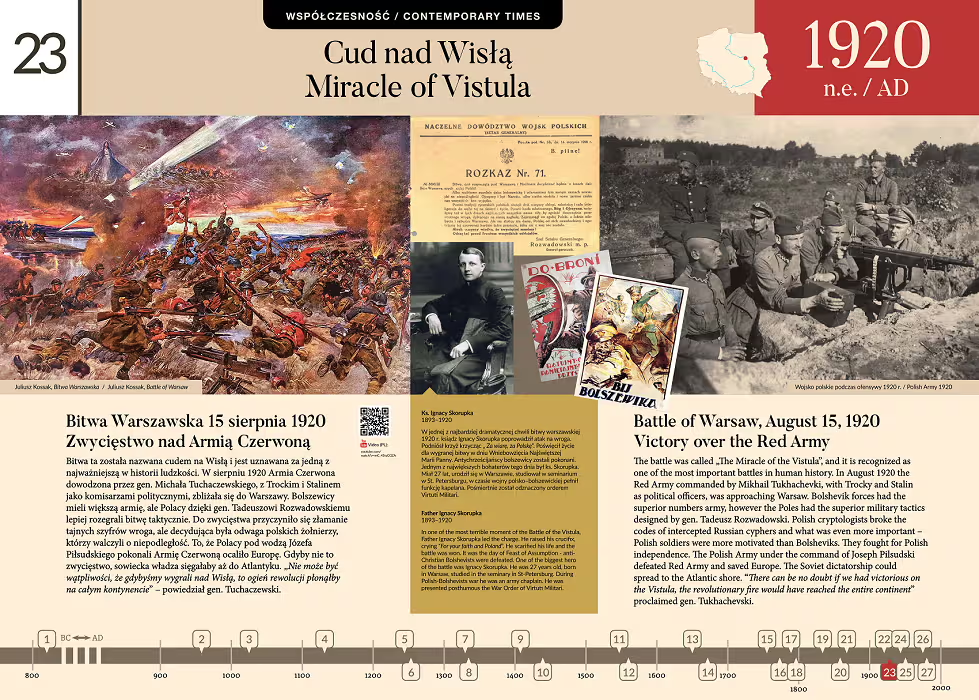
The Miracle of the Vistula, also known as the Battle of Warsaw, was a decisive Polish victory over the Soviet Red Army in August 1920. Led by Józef Piłsudski, Polish forces halted the Soviet advance and secured the newly restored independence of Poland. The victory prevented the spread of communist revolution into Western Europe and is regarded as one of the most important battles of the twentieth century. Remembered as a triumph of courage, strategy, and determination, the battle became a defining moment in modern Polish history.
Contemporary
1939 AD
Start of the World War II
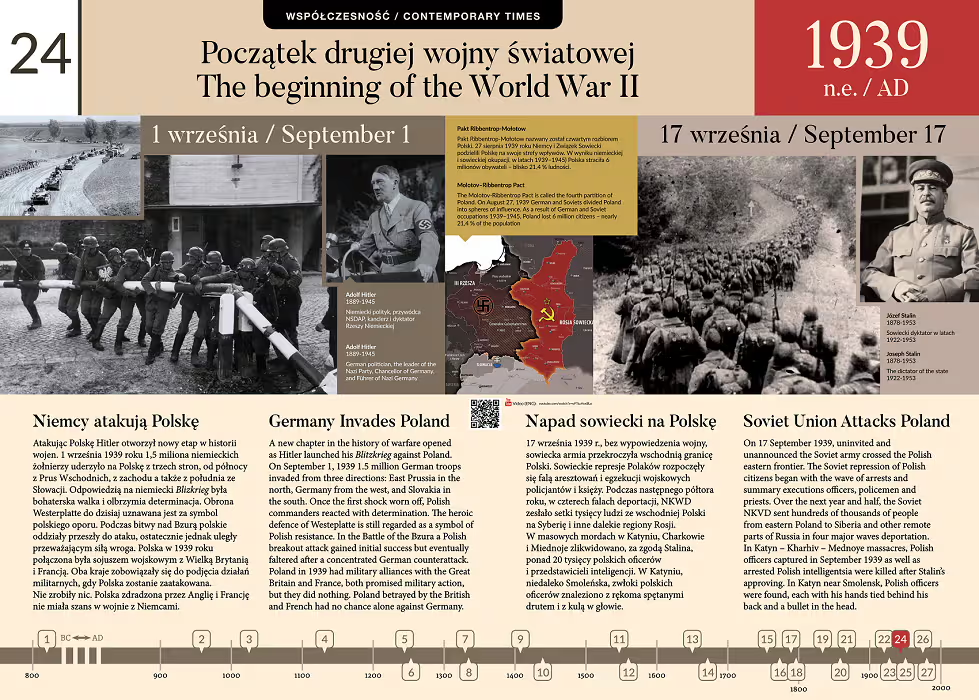
The outbreak of World War II began with the German invasion of Poland on September 1, 1939, followed by the Soviet invasion from the east on September 17 under the secret terms of the Molotov-Ribbentrop Pact. Despite fierce resistance, Poland was overwhelmed by the combined forces of Nazi Germany and the Soviet Union. The occupation brought immense suffering, including mass arrests, deportations, executions, and atrocities such as the Katyn Massacre. Though Poland was conquered, its people continued the fight through resistance movements and armed forces that contributed significantly to the Allied war effort.
Contemporary
1944 AD
Warsaw Uprising
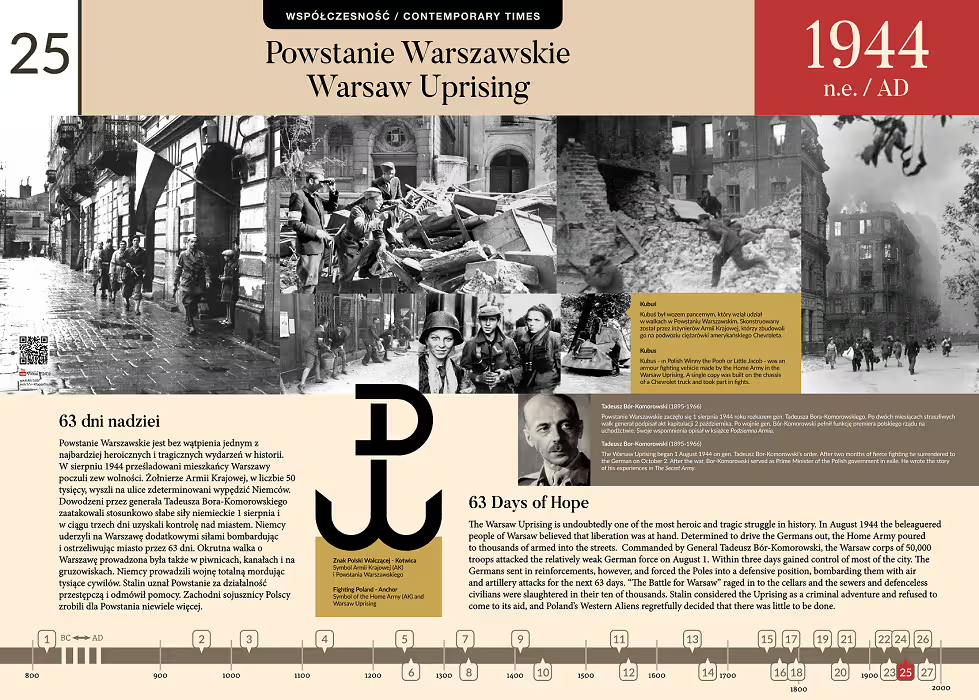
The Warsaw Uprising of 1944 was a courageous effort by the Polish Home Army and the citizens of Warsaw to liberate their capital from German occupation before the arrival of Soviet forces. For 63 days, thousands of fighters and civilians resisted overwhelming enemy forces in one of the most heroic acts of resistance during World War II. Despite extraordinary bravery, the uprising was ultimately crushed, and much of Warsaw was systematically destroyed. The sacrifice of the insurgents became a lasting symbol of Poland's determination, resilience, and commitment to freedom.
Contemporary
1978 AD
Cardinal Karol Wojtyla elected Pope
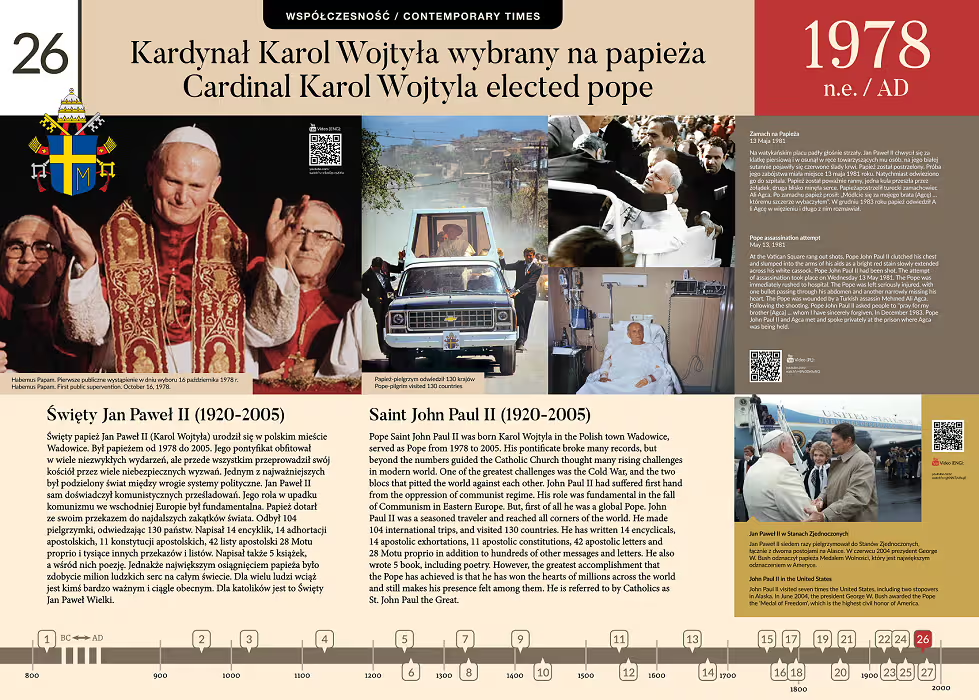
In 1978, Cardinal Karol Wojtyła of Poland was elected pope, becoming Pope John Paul II and the first non-Italian pope in more than 450 years. His papacy inspired millions around the world and played a significant role in promoting human dignity, religious freedom, and peaceful social change. Through his leadership and historic visits to Poland, he helped strengthen the spirit of resistance against communist rule in Eastern Europe. Saint John Paul II remains one of the most influential figures in modern history and a source of pride for Poles worldwide.
Contemporary
1980-89 AD
Communism Abolished in Poland
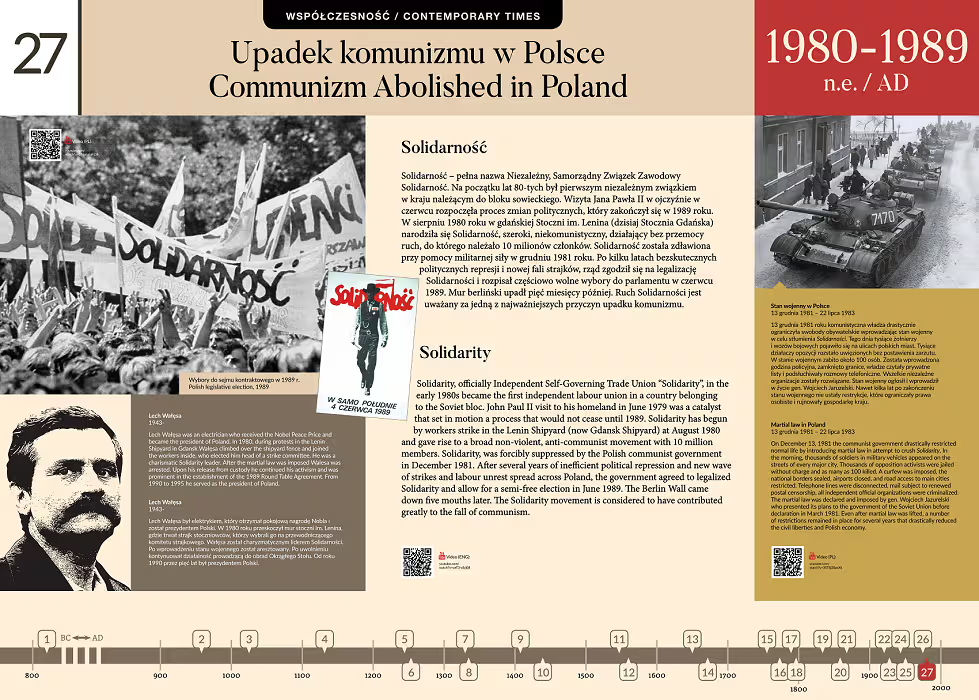
Between 1980 and 1989, the Solidarity movement emerged as the first independent labor union in the Soviet bloc and became a powerful force for democratic change in Poland. Led by Lech Wałęsa, millions of Poles united to challenge communist rule through peaceful protest, civic action, and negotiations. Despite periods of repression and martial law, the movement continued to grow, inspiring people throughout Eastern Europe. The success of Solidarity helped bring about the fall of communism in Poland and contributed to the broader collapse of communist regimes across the region.